Henrik Vanger’s Heart Attack
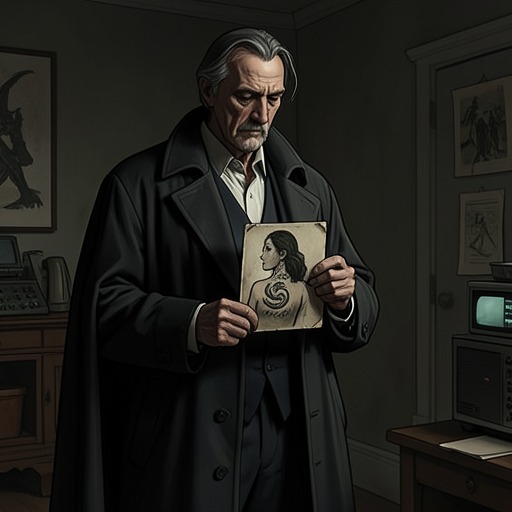
The Girl with the Dragon TattooHenrik Vanger’s Heart Attack occurs at the most precarious point in Mikael Blomkvist’s investigation into Harriet Vanger’s disappearance. After months of apparent stagnation, Blomkvist begins to decode the evidence surrounding Harriet’s Bible, the numbered references to Leviticus, and the photograph taken during the Children’s Day parade. When he tells Henrik Vanger part of what he has discovered, Henrik soon collapses with severe chest pain. The attack transforms the investigation from a private search for a lost girl into a crisis in which the pursuit of truth may itself have placed its principal witness at risk.
Causes and Immediate Circumstances
The attack follows a sudden breakthrough. After six months of fruitless thought, Blomkvist recognizes that the first photograph in the album is not another image of the Hedeby Bridge accident but the last photograph taken of Harriet on the day she vanished, while she watched the Children’s Day parade in Hedestad. This neglected image becomes the first of three new pieces of evidence that crack open the case. Blomkvist then studies Harriet’s Bible and realizes that the apparently meaningless figures in her notes indicate chapters and verses in Leviticus. The marked passages concern violent or forbidden acts, including sexual transgression, ritualized killing, and punishment by death.
Blomkvist shares some of this new evidence with Henrik before the attack. The timing gives the event its central ambiguity: the medical cause is a serious heart condition, but Blomkvist fears that the shock of the revelations helped bring it on. He later tells Dirch Frode that he is very much afraid his conversation with Henrik contributed to the collapse. The fear is not presented as a proven medical conclusion; it is Blomkvist’s burden of responsibility at the moment when investigative progress collides with Henrik’s age and vulnerability.
What Happens
Just before 1:00 a.m., while Blomkvist is still at the kitchen table reading Harriet’s Bible, a car crosses the bridge at high speed. He sees the flashing blue lights of an ambulance and runs to Henrik’s house, where all the ground-floor lights are on. Anna, the housekeeper, tells him that Henrik woke with pains in his chest and then collapsed. The medics carry Henrik out unconscious on a stretcher, while Martin Vanger follows in a visibly disordered state, having been summoned from bed by Anna.
Blomkvist immediately assumes a practical responsibility. He offers to go to Frode’s house and wake him with the news, then tells Frode that Henrik has been taken to hospital and that the doctors believe it is a heart attack. Frode notices that the attack has occurred on Friday the thirteenth, a detail that adds an ominous superstitious echo to an otherwise concrete medical emergency. The next evening Frode reports that Henrik is alive but not doing well: he has suffered a serious heart attack and is also suffering from an infection.
The crisis initially seems to threaten the investigation’s continuity as much as Henrik’s life. Blomkvist waits for news while repeatedly going over his materials and remaining in close contact with Frode. The case had depended on Henrik’s memory, authority, and sustained interest; his incapacity raises the possibility that the search for Harriet may lose its sponsor and its most important personal witness at the very instant when the evidence is becoming legible.
Consequences for the Investigation
The attack produces a temporary interruption rather than an ending. By Thursday evening, Frode brings word that the immediate crisis appears to be over and that Henrik wants to see Blomkvist as soon as possible. Around 1:00 p.m. on Midsummer Eve, Blomkvist therefore drives to Hedestad Hospital. His attempt to reach Henrik is complicated by Birger Vanger, who angrily blocks his way and insists that Henrik cannot receive visitors. The scene shows how quickly Henrik’s illness alters access to the investigation: information that had circulated through Henrik’s household is now controlled by relatives and medical circumstances.
Henrik’s eventual survival allows the inquiry to continue, but the attack changes its emotional and ethical conditions. Blomkvist can no longer treat the case as an abstract reconstruction of a disappearance preserved in police reports, photographs, family albums, and private records. The materials have become dangerous knowledge for the person who has carried the disappearance for decades. The possibility that a revelation can injure its recipient makes the investigation’s progress inseparable from questions of timing, secrecy, and responsibility.
The attack also sharpens the contrast between different forms of evidence. Detective Inspector Gustaf Morell’s original report had preserved the disappearance in objective, detailed prose, while Henrik had preserved it through repeated examination of photographs and personal memory. Blomkvist’s new interpretation arises from the neglected first photograph and Harriet’s marked Bible, not from a fresh physical discovery. Henrik’s collapse demonstrates that archival evidence is not inert: once interpreted, it re-enters living relationships and can produce immediate bodily consequences.
Narrative Significance
As a narrative event, Henrik Vanger’s Heart Attack is a reversal from investigative momentum to mortal uncertainty. Blomkvist has moved from six months of “fruitless cogitation” to a chain of discoveries: Harriet’s final photograph, the Leviticus code, and further recognition of the people concealed by mistaken identifications in the family archive. The attack interrupts that acceleration and makes the cost of recognition visible. Knowledge promises liberation from the past, yet its arrival threatens the health of the person most invested in obtaining it.
The event also deepens the novel’s recurring structure of delayed testimony. Harriet’s increasingly private religious life, her withdrawal from friends, and her movement from Sunday school and church toward a Pentecostal congregation and then Catholic reading had already suggested that something troubling had happened to her. Her Bible turns that inward crisis into a decipherable record, while Henrik’s collapse shows another body bearing the pressure of a long-suppressed history. The case advances not through a single authoritative account but through the collision of police documentation, photographs, religious texts, family silence, and the physical reactions of those who encounter the truth.
Henrik’s recovery preserves the possibility of a reckoning. Frode later brings Blomkvist a letter in which Henrik affirms his respect for Blomkvist’s integrity and says that Blomkvist may write and publish whatever he wishes, without pressure, while their contract remains valid. That letter matters because it restores agency after the period in which Henrik’s body and household had seemed to close the investigation down. The heart attack therefore becomes both a warning and a threshold: it reveals the danger of uncovering the past, but it does not permit the past to remain buried.